The Most Expensive Bearing Is Often the One You Replace Too Soon
Large industrial bearings are often treated as replacement items.
When they reach a certain age, show signs of wear, or become a concern during maintenance planning, the decision is often reduced to two options: keep running or replace with a new one. That approach is understandable. In production environments where downtime is costly, maintenance teams often make conservative decisions to protect reliability.
But replacing a bearing too early can also be expensive. Not because the replacement itself is wrong, but because the remaining value in the bearing may never be assessed, recovered, or used.
For large bearings such as spherical roller bearings, CARB toroidal roller bearings, slewing bearings, specialised application bearings, and bearing housings, this can represent a meaningful loss over time. These are not minor consumables. They are high-value assets that influence uptime, maintenance costs, lead-time exposure, and operational performance.
The strongest reliability strategies are not built around replacing everything early or waiting until failure. They are built around better lifecycle decisions.
Bearings Should Be Managed Like Assets
A large bearing has value beyond its purchase price.
It represents material, manufacturing effort, application engineering, installation cost, lead time, maintenance planning, and operational risk. Once installed, its value is linked directly to the performance of the equipment around it. When that bearing is treated only as a consumable, important decisions are often missed.
A bearing may be replaced as a precaution without understanding how much usable life remains. Another may be left in service until damage becomes too severe to recover. In both cases, the operation loses options.

Managing bearings as assets means asking better questions:
- What condition is the bearing in?
- What risk does it currently represent?
- Can deterioration be detected early?
- Can removal be planned before failure?
- Does the bearing still hold recoverable value?
- Is replacement with a new one the only sensible decision?
These questions shift the conversation from replacement habit to lifecycle management.
Timing Matters
The point at which a bearing is removed matters.
If it is left in operation until severe damage occurs, the opportunity for reuse, recovery or remanufacturing may be lost. Once damage becomes too advanced, replacement may be the only practical option. At the same time, removing a bearing too early can mean discarding value that could still have been recovered.
This is where condition monitoring becomes important. It helps identify wear, defect progression, lubrication issues, and early-stage failure patterns before damage becomes irreversible. That visibility creates a window for planned intervention, inspection, and better decision-making.
The objective is not to make bearings last forever. The objective is to maximise the value extracted from every bearing throughout its lifecycle while maintaining reliability and reducing avoidable costs.
Remanufacturing Changes the Economics
In suitable applications, SKF Bearing Remanufacturing offers an alternative between running to failure and buying new.
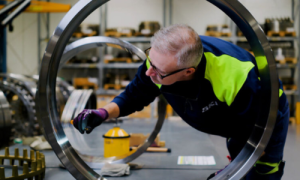
A bearing that is removed at the right time can be inspected, measured and restored through SKF processes. Where suitable, this can return the bearing to service with SKF quality assurance and warranty support. For many large bearing applications, this can change the economics of maintenance planning.
Instead of automatically replacing with new, the operation may be able to recover value from an existing bearing, reduce lifecycle cost, and improve availability. In many cases, remanufacturing may offer a shorter lead-time profile than sourcing a new large bearing, depending on bearing type, condition, and local programme capacity.
This does not mean every bearing should be remanufactured. It means every critical bearing should be considered properly before its remaining value is discarded.
OEM Assurance Matters
One of the main concerns around remanufacturing is trust. Many decision-makers worry that a remanufactured bearing is simply a repaired bearing.
SKF Bearing Remanufacturing is different because the bearing is assessed and restored by the original manufacturer, using SKF-defined standards, inspection processes, quality controls and acceptance criteria designed for OEM remanufacturing. The decision is not between a new bearing and an uncertain repair. It is whether a suitable bearing can be returned to service through a controlled OEM remanufacturing process, backed by an SKF warranty.
We unpack the full assessment process, warranty position, turnaround times and suitability criteria in our practical guide to bearing remanufacturing.
Better Lifecycle Decisions Also Reduce Waste
Cost and reliability are often the main drivers behind remanufacturing decisions, especially in Southern African industrial environments.
However, there is also an environmental benefit. When a bearing is successfully remanufactured, much of the material, energy, and manufacturing effort already invested in that bearing is retained rather than discarded. SKF can also provide customers with documented carbon emissions savings associated with remanufacturing programmes.
For many organisations, this supports a practical outcome: lower lifecycle cost, reduced waste, and performance and warranty assurance governed by SKF’s remanufacturing assessment and acceptance process. This should not be treated as a sustainability slogan.
It is simply better asset management.
Reliability Requires Lifecycle Thinking
The strongest maintenance decisions are made before failure removes the available options.
For large bearings, that means building a clear pathway:
- Condition monitoring
- Planned removal
- Inspection
- Asset decision-making
- SKF Bearing Remanufacturing, where suitable
- Return to service
This approach helps move bearing decisions away from reactive replacement and towards planned lifecycle optimisation.
The question for industrial operations is simple:
What happens to your large bearings when you replace them?
In many plants, the answer is that they are scrapped, stored, or forgotten. But those bearings may still hold value. A review of critical bearing applications can help identify where lifecycle decisions could reduce cost, shorten lead time, reduce waste, and improve long-term reliability. Large bearings should not be judged solely by their purchase price. They should be judged by the value they deliver over their full lifecycle.
The next replacement decision should not be made by default. It should be made with a clear view of condition, risk, recoverable value, lead time, and lifecycle cost.